
Start here
A demo on a laptop can look clever. Live work is different. The moment an AI helper can touch money, files or a customer, someone still has to be responsible.
An agent is a helper that can take a goal and do several steps on its own. That saves time when the job is real. It also goes wrong when nobody is watching.
This article is about putting that helper on work you already do — WhatsApp, your CRM and the files on your desk. A public model does not know your business until those tools are connected.
Chatbot, rule or agent
A chatbot is for talk. Someone asks “Where is my order?” or “What are your hours?” and they get a fast answer. When the chat gets messy, a person steps in.
A rule is for work that never changes. If the invoice is late, send a reminder. Same path every time. Clear steps. No guessing.
An agent sits in the middle. You give it a goal: check the order, message the customer and update the CRM. It chooses the next step. That is why people like the demo. It is also why a live run can surprise you — because the path is not fixed.
What companies are seeing right now
On 22 September 2026, Proofpoint shared a simple picture of how far this has already gone. 87% of organisations said their AI assistants had moved past a small test. 76% were trying or rolling out agents that can act on their own. Still, 52% were not sure they could tell if that AI had been compromised.
A week earlier, on 15 September 2026, Google’s developers wrote about “zero-trust” agents. The idea is easy to hold: do not trust an agent just because the prompt looks fine. Check what it is trying to do before it runs the tool.
You do not need those products. You do need the lesson. Going live is not the same as being ready.
When an agent is the wrong tool
If the work never changes, keep a rule. Payroll dates, stock reorder points or a fixed WhatsApp status text do not need a helper that invents extra steps. An agent will only slow you down.
If the work is only talk, start with a chatbot. For most Hyderabad shops and service firms, that is enough for the first month.
Bring in an agent when the path bends a little each time — a ticket that needs a lookup, a message and an update, or a lead that needs a follow-up, a note in Zoho and a yes or no from a person. That is a real job. It is not “run the whole company.”
What production actually needs
Start with one process, not ten. Pick the work that already wastes the most hours — maybe order status, maybe lead follow-up, maybe first-line support. Finish that one before you add another.
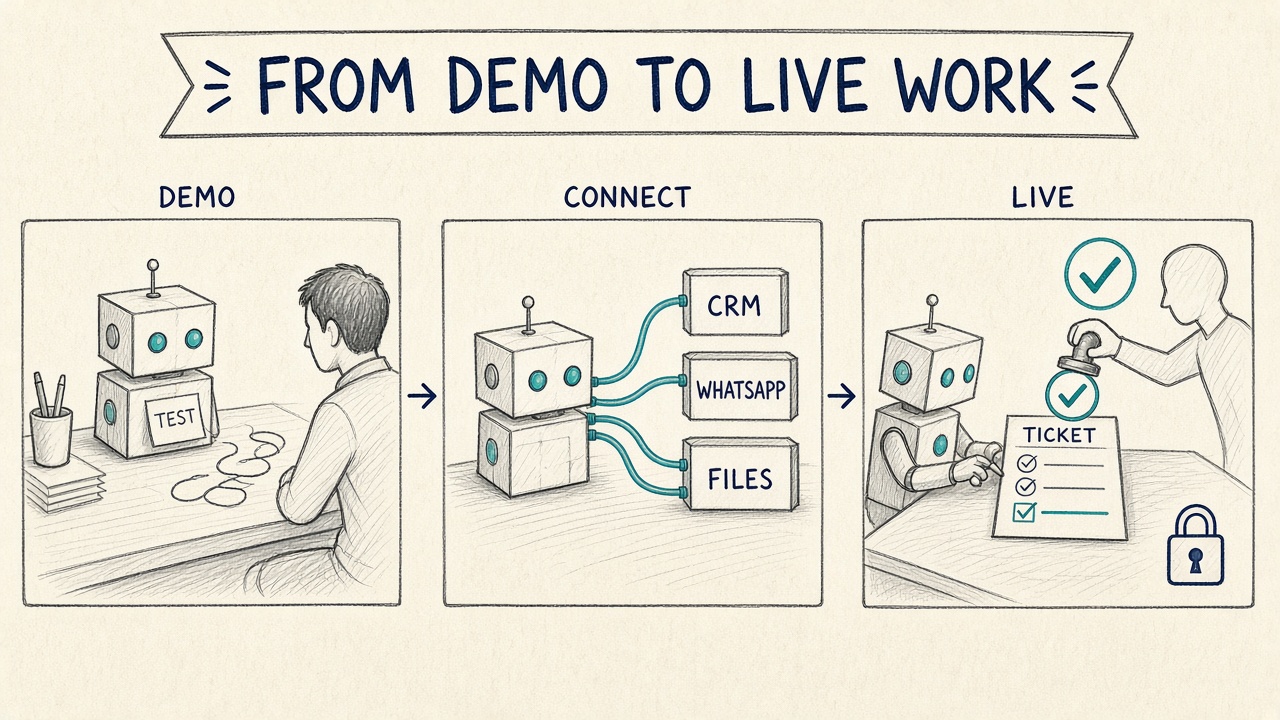
Then give it connections. An agent cannot “know” your business unless it can see CRM, WhatsApp, orders or files. That is integration work. A public model sitting in a browser will not do it for you.
Keep a person on the hard steps. Refunds, legal, angry customers and prices should not go out on their own. The agent can draft. A person sends or signs.
And keep a log. Who asked, what the agent did and what it changed. If you cannot open that later, you cannot trust it on a busy Tuesday.
Two mistakes we keep seeing
The first is handing over every password on day one. People connect email, bank, CRM and WhatsApp in one sitting, then they are surprised. Start with read-only where you can. Give write access only for the one task.
The second is treating a nice demo as a finished product. A chat on a laptop is a test. Production means real customers, real data and someone on call when it fails at 9pm.
The better habit is small. Watch one process for a week. Fix the one action that would embarrass you. Then add the next step.
If you run a team in Hyderabad
You do not need a Silicon Valley “agent platform.” You need one workflow that already hurts. Put AI on the repeat part and keep people for review and the customer.
The job is not “let the tool send everything.” Use it. Then decide.
LogiQGen can help with that first workflow — a chatbot, a helper on your files or a connection to the tools you already use. Book a free AI audit if you want it written down.
Common questions
Is an agent better than a chatbot? Not always. If you only need answers, start with chat. Add an agent when it must take steps inside your tools.
Can we skip connecting our tools and just use a public model? Use a public model for drafts. Your orders and customer chats still have to be connected if the helper is going to do real work.
Is this only for big companies? No. A small Hyderabad team can start with one WhatsApp flow and one CRM field. Big programmes fail when they skip that first, boring step.