
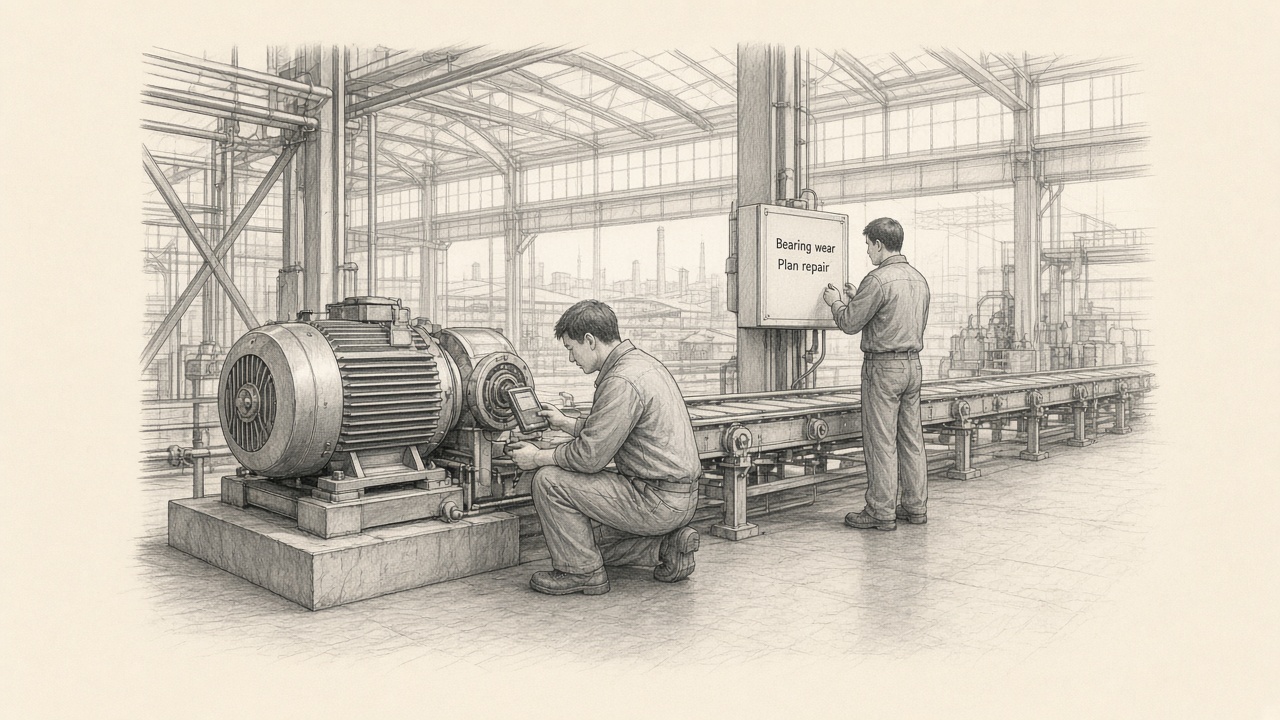
What does an unplanned stop actually do to a shift?
A factory can lose an hour in a way a spreadsheet never shows. The line stops. The batch in progress waits. The next job cannot start. People stand at the machine while someone looks for a spare, and the dispatch that was promised for the evening starts to slip.
The expensive part is often the surprise. A bearing, a motor, a pump, or a compressor fails in the middle of a run. Maintenance can fix it. They just cannot choose the hour. Overtime, a missed truck, and a restart that takes longer than the repair itself all sit on top of the broken part.
Predictive intelligence is a way to hear that part while it is still working. The machine stays in the shift. The repair moves to a window the factory already owns, such as a changeover, a Sunday, or the end of a batch.
What does predictive intelligence mean on a production line?
It means a warning that a machine is leaving its normal pattern, early enough that someone can plan the repair. Vibration, temperature, current, pressure, or the time a cycle takes can all drift before a part actually fails. A model that has seen the healthy pattern can point at that drift.
This is different from a dashboard that turns red after the line has already stopped. A red light at the moment of failure tells the team what they can already see. A useful warning arrives while the machine is still making parts, and it names the asset, the signal, and how far the reading has moved from the machine’s own normal.
It is also different from a fixed service interval. A calendar says “change it every six months” whether the part is tired or not. A prediction follows the machine in front of you. A quiet motor can stay in service. A noisy one can be opened before Friday’s run.
Which stops can a warning move into a planned window?
Wear you can hear in the data before the break. A bearing that vibrates a little more each week. A motor that draws more current for the same load. A pump whose pressure is slowly falling. These are the stops a maintenance lead can often move, because the part gives a signal and the spare can be on the shelf before the shift needs it.
A machine the factory cannot afford to lose in the middle of a run. One bottleneck asset is a better start than a sensor on every motor in the building. If that asset stops, the rest of the line waits. Watching that one machine closely reduces more downtime than a thin view of fifty machines.
A repair that already has a home in the week. The warning is only useful if there is a place to use it: the next changeover, the planned cleanup, or a short stop the planner can protect. Prediction does not create spare hours. It lets the team spend the hours they already have on the part that is actually tiring.
What should a person on the maintenance team still decide?
Whether this warning is the one to act on. A model can rank a drift. The person who knows the machine decides if today’s batch can finish, if the spare is real, and if opening the housing now would cost more than waiting until the planned stop.
A failure that had no warning. A snapped belt, a wrong setting after a changeover, a jam, or a power cut will still stop the line. Predictive intelligence does not cover every stop. The team still needs the breakdown routine they already trust.
Safety and quality calls. An alert is not permission to keep running a machine that is hot, leaking, or out of guard. It is also not a substitute for the inspection that decides whether a batch is fit to ship. The warning queues the work. The engineer owns the decision.
Where should the warning come from?
The warning has to be tied to a named machine and a signal the team can check with their own eyes or their own meter. “Asset 12, bearing housing, vibration above its normal” is a job. “Anomaly detected” is a puzzle. If the maintenance lead cannot find the part, the alert will be ignored by the second week.
The normal pattern should come from that machine, not from a generic factory on the internet. Two motors of the same model can live different lives. The baseline is the healthy weeks of the asset you are watching. When the process changes, a new product, a new speed, or a rebuilt motor, the baseline has to be taught again or the warning will cry wolf.
Someone has to own the list. A message that lands in a group chat at midnight, with no name on it, becomes noise. The useful setup is a short list the planner opens at the start of the day: which asset, which signal, and which planned window can take the repair.
LogiQGen builds this kind of watch for factories that want fewer surprise stops. Sensors and the plant’s own history feed the warning. A person on the maintenance team still chooses the hour and does the repair.
What should a factory put in place before switching this on?
One asset and one failure you still remember. The last unplanned stop that hurt a dispatch is a better teacher than a catalogue of every sensor available. Start there. If that failure left a trace in vibration, heat, or current, it is a candidate. If it was a one-second jam, it is not.
A baseline of healthy running. A few clean weeks, or a history export the maintenance system already keeps. Without a normal, every reading looks like a warning.
A spare and a window. A prediction that arrives when the part is six weeks away on a purchase order does not save the shift. Pair the alert with the spare you can actually hold and the stop you can actually schedule.
A person who will close the alert. Name the planner or the shift lead. In the first month, have them mark which warnings were real, which were a process change, and which were noise. Those marks are how the watch gets stricter.
Most plants do not need the whole floor connected on day one. One bottleneck machine, one signal, and a planned window are enough to learn whether the warning arrives in time.
Questions factories ask before they try this
Will this stop every breakdown? No. It reduces the stops that announce themselves early, such as wear in a bearing, a motor, a pump, or a compressor. Sudden jams and wrong settings still need the team on the floor.
Do we need sensors on every machine? No. Start with the asset whose surprise stop costs the rest of the line. Add the next machine only after the first warning is something the planner uses.
What if the alert is wrong? Treat the first weeks as a check. A false warning should be marked, especially after a speed change or a repair. A model that is never corrected will be muted. A model that is corrected starts to sound like the maintenance lead.
Can an old machine be watched? Yes, if there is a place to read vibration, temperature, or current, and a history of how that machine sounds when it is healthy. Age is not the barrier. A missing normal reading is the barrier.
How do we start without stopping production to install a large system? Put the watch on one machine during a stop you already planned. Leave the breakdown routine as it is. Use the first real warning to book a repair in the next window, and widen only after that repair was on time.