
What Is AIoT And Why Does It Matter For Manufacturing In Hyderabad?
AIoT is the convergence of artificial intelligence and the Internet of Things. In a manufacturing context, it means placing intelligent sensors on your equipment, production lines, and environment — then feeding that sensor data into AI models that can detect anomalies, predict failures, and optimize operations in real time.
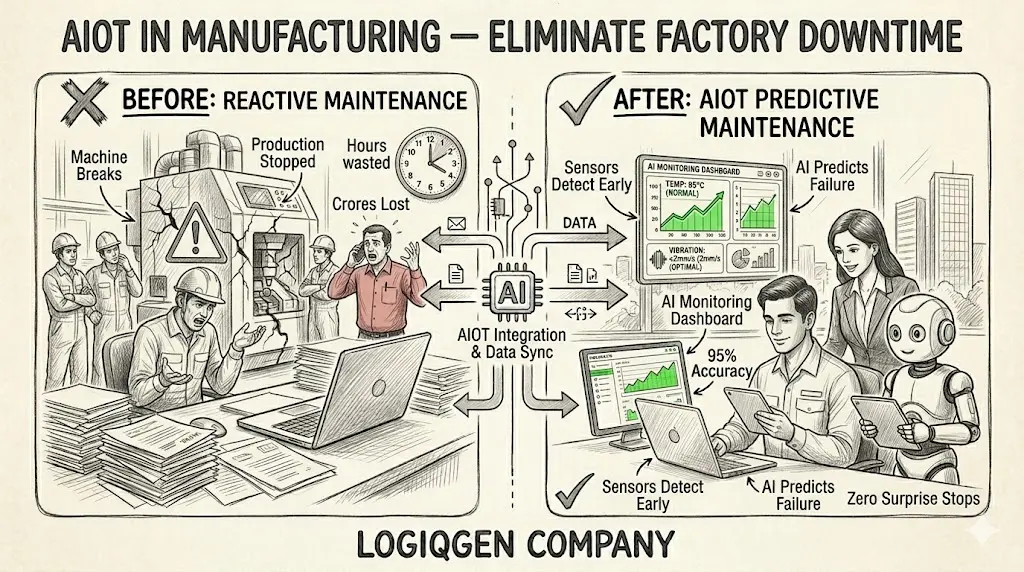
Traditional factory monitoring is reactive. A machine breaks down, the maintenance team scrambles to fix it, production stops for hours or days, and the cost cascades through the entire supply chain. AIoT flips this model entirely. Sensors continuously measure vibration, temperature, pressure, power consumption, and dozens of other parameters. AI algorithms analyze these readings against historical patterns and flag potential failures days or weeks before they actually occur.
For Hyderabad's growing manufacturing sector — spanning pharmaceuticals, automotive components, electronics, and textiles — the shift from reactive to predictive operations is not incremental. It is the difference between losing crores to unplanned stops and running production lines that rarely halt unexpectedly. The Telangana State Industrial Infrastructure Corporation reports that industrial output in the Hyderabad metropolitan area has been growing steadily, with manufacturers under increasing pressure to meet delivery timelines while maintaining quality standards. AIoT provides the operational backbone that makes this achievable without proportionally increasing maintenance headcount.
What Are The Five Biggest Problems AIoT Solves On The Factory Floor?
Unplanned equipment downtime. This is the most expensive problem in manufacturing. A single hour of downtime on a high-value production line can cost lakhs. AIoT sensors track equipment health continuously and AI models identify degradation patterns weeks in advance — giving your maintenance team time to schedule repairs during planned stops instead of emergency shutdowns.
Quality defects reaching customers. Manual quality inspection catches defects after they happen. AI-powered vision systems and sensor arrays inspect every unit in real time during production — detecting dimensional variations, surface defects, and material inconsistencies that human inspectors would miss at production speed. Defect rates drop and scrap waste shrinks.
Energy waste across operations. Most factories consume 15 to 30 percent more energy than necessary because equipment runs at suboptimal settings. AIoT monitors energy consumption at the machine level and AI algorithms adjust operating parameters — motor speeds, compressor cycles, heating profiles — to minimize waste without affecting output quality.
Blind spots in supply chain timing. AIoT connects your production data with inventory and logistics systems. AI models forecast raw material consumption based on actual production rates, trigger reorders at precisely the right moment, and alert you to supply chain disruptions before they cause line stoppages.
Inconsistent production output. Even when machines are running, output varies. Temperature fluctuations, material batch differences, and operator variations all affect yield. AIoT tracks every variable that influences output quality and AI models continuously adjust process parameters to maintain consistent results — shift after shift, batch after batch.
How Does AIoT Work In Practice — From Sensors To Decisions In Hyderabad Factories?
The process starts with sensor deployment. We install industrial-grade sensors on your critical equipment — vibration sensors on rotating machinery, thermal sensors on electrical systems, pressure transducers on hydraulic lines, and current monitors on motors. These sensors transmit data every few seconds to an edge computing gateway on your factory floor.
The edge gateway performs initial processing — filtering noise, aggregating readings, and running lightweight anomaly detection models locally. This means the system responds to critical alerts in milliseconds, not minutes. It does not depend on cloud connectivity for time-sensitive decisions. Even if your factory's internet connection drops for hours, the edge system continues monitoring and responding to critical anomalies independently — a resilience feature that cloud-only solutions cannot provide.
Processed data flows to the central AI platform where more sophisticated models run. These models compare current equipment behavior against baseline patterns established during healthy operation. When the vibration signature of a bearing starts deviating from its normal pattern — even slightly — the AI flags it as an early warning and estimates remaining useful life.
The platform presents all of this through a dashboard that your plant manager and maintenance team can access on any device. No specialized training required. Clear alerts, prioritized action items, and trend visualizations that show exactly what needs attention and how urgently.
Which Manufacturing Sectors In Telangana Gain The Most From AIoT?
Pharmaceutical Manufacturing — GMP compliance requires precise environmental control and batch documentation. AIoT automates environmental monitoring (cleanroom pressure, temperature, humidity), tracks batch parameters in real time, and generates audit-ready compliance records automatically.
Automotive Component Manufacturing — CNC machines, stamping presses, and assembly robots require precise calibration. AIoT predicts tool wear before it causes dimensional drift, monitors weld quality in real time, and ensures every component meets specification without relying solely on end-of-line inspection.
Electronics and PCB Assembly — Surface mount technology lines run at high speed with microscopic tolerances. AI-powered optical inspection catches solder defects, component misalignment, and board contamination at production speed — catching failures that manual inspection simply cannot detect consistently.
Textile and Garment Manufacturing — Loom monitoring, dye consistency tracking, and fabric defect detection all benefit from AIoT. Sensors on looms detect thread tension anomalies that cause fabric faults. AI vision systems flag color and weave defects in real time across hundreds of meters of fabric per hour.
Food and Beverage Processing — Temperature and humidity control is critical throughout production and storage. AIoT provides continuous cold chain monitoring, alerts when storage conditions deviate from FSSAI-mandated parameters, and automates batch traceability documentation. For Hyderabad's growing packaged food sector, this ensures both product safety and regulatory compliance without manual temperature logging. When a food safety audit requires six months of temperature records for every storage unit, AIoT generates them in seconds rather than requiring staff to compile handwritten logs.
What Results Can Hyderabad And Telangana Manufacturers Expect From AIoT?
Factories that deploy AIoT predictive maintenance typically see unplanned downtime reduce by 40 to 60 percent within the first six months. That alone usually justifies the entire investment. But the compounding effects go further — maintenance costs drop because you replace parts at the right time (not too early, not too late), energy bills decrease as equipment runs at optimal efficiency, and product quality improves because process parameters stay within tighter tolerances.
The data itself becomes a strategic asset. After six months of continuous monitoring, the AI develops a behavioral fingerprint for every machine in your facility — unique vibration signatures, thermal profiles, load curves, and degradation trajectories that are specific to your exact equipment and operating environment. No consultant or equipment manufacturer can provide this level of insight because it can only be built from sustained observation of your actual production conditions.
Factories that adopt AIoT first in their sector gain a structural advantage — lower unit costs, faster delivery commitments, and quality consistency that becomes a selling point with procurement teams. The longer you wait, the wider the operational gap grows between your production line and the ones already running on predictive intelligence.
What Does AIoT Implementation Look Like In The First 90 Days?
Week one through two is the site assessment phase. Our engineering team walks your factory floor, identifies critical equipment, maps existing monitoring infrastructure, and documents the maintenance history of your highest-value machines. We interview your plant manager, maintenance supervisor, and line operators to understand which failures cause the most damage and which machines they worry about most. This assessment determines exactly where sensors go and what AI models we need to build.
Week three through four is sensor installation and connectivity. Industrial-grade sensors are mounted on priority equipment — typically 10 to 15 machines in the first phase. Each sensor is calibrated for your specific equipment characteristics. The edge computing gateway is installed and configured to receive data from all sensors simultaneously. During this phase, we establish the baseline — recording normal operating patterns so the AI knows what healthy equipment looks like in your specific environment.
Week five through eight is the learning and calibration period. AI models ingest the continuous sensor data stream and build behavioral profiles for each machine. The system begins generating its first alerts — initially with human verification to calibrate sensitivity. False positive rates decrease rapidly as the model learns the difference between normal operational variance and genuine degradation signals specific to your equipment.
Week nine through twelve is the optimization phase. By this point, the system has enough historical data to make reliable predictions. Alert accuracy typically exceeds 85 percent. The maintenance team starts scheduling preventive interventions based on AI recommendations. The first measurable reductions in unplanned downtime become visible. The dashboard is refined based on operator feedback to show exactly the information your team needs in the format they find most actionable.
How Does AIoT Pay For Itself In Indian Manufacturing Economics?
The financial case for AIoT is straightforward when you quantify what unplanned downtime actually costs. Take a mid-sized pharmaceutical manufacturing line in Hyderabad producing tablets or capsules. An unplanned four-hour stoppage does not just cost four hours of lost production. It triggers batch rejection if the product was mid-process. It requires cleaning validation before restart. It delays downstream packaging and dispatch. It may breach delivery commitments to distributors. The fully loaded cost of that single event — lost output, wasted materials, overtime labor, penalty clauses — routinely reaches 8 to 15 lakhs.
If that production line experiences unplanned stoppages six to eight times per year, the annual cost of reactive maintenance is 50 lakhs to 1.2 crores in direct losses alone. An AIoT system that reduces those events by half delivers 25 to 60 lakhs in annual savings. The system typically costs a fraction of the first year's savings to install and operate — producing positive ROI within four to six months.
Beyond downtime avoidance, AIoT delivers savings through optimized spare parts inventory. Without predictive data, factories stockpile expensive replacement parts as insurance against unexpected failures. With AIoT, you know which parts will need replacement and approximately when. Spare parts procurement becomes planned rather than emergency, reducing inventory carrying costs by 20 to 35 percent while simultaneously eliminating the risk of not having the right part when you need it.
Energy optimization adds another layer of savings. Factories operating compressed air systems, HVAC, industrial chillers, and heavy motors typically reduce their electricity bills by 10 to 20 percent once AIoT identifies and corrects inefficiencies that have been silently costing money for years — compressors running during idle periods, motors operating at higher loads than necessary, heating systems overshooting target temperatures.
The insurance and audit benefits are often overlooked. Factories with documented AIoT monitoring can demonstrate proactive maintenance practices to insurers — potentially reducing equipment insurance premiums. During quality audits and regulatory inspections, the ability to produce time-stamped sensor logs and automated compliance records dramatically reduces preparation time and audit findings. One pharmaceutical manufacturer we spoke with estimated they saved three full days of pre-audit preparation per quarter after implementing comprehensive AIoT monitoring.
Workforce safety improvements round out the financial picture. Temperature sensors in hazardous environments, vibration monitoring on equipment that could fail catastrophically, and gas detection sensors in chemical processing areas all contribute to a safer workplace. Beyond the ethical imperative, workplace accidents carry direct costs — medical expenses, production stoppage, regulatory penalties, and insurance claims — that AIoT helps prevent through continuous environmental monitoring and automated hazard alerting.
Frequently Asked Questions About AIoT For Hyderabad Manufacturers
How much does an AIoT system cost for an Indian factory? Costs depend on the number of machines monitored and the types of sensors required. A pilot deployment covering 5 to 10 critical machines typically starts from a few lakhs. Full factory deployments scale based on scope. LogiQGen provides a detailed cost estimate after a free on-site assessment of your facility.
Can AIoT sensors work on our existing old machines? Yes. AIoT is designed for retrofitting. Sensors are mounted externally on existing equipment — no modifications to the machine are needed. Whether your equipment is 2 years old or 20 years old, vibration, temperature, and current sensors can be added without affecting machine operation.
What happens if the internet connection drops in the factory? The edge computing gateway on your factory floor continues monitoring and responding to critical alerts independently of internet connectivity. Data is stored locally and syncs to the central platform when connectivity resumes. Critical alerts are never missed.
How long does AIoT deployment take from start to first results? Sensor installation takes 1 to 2 weeks. The AI learning period runs 4 to 6 weeks. First reliable predictive alerts typically begin by week 8 to 10. Measurable downtime reduction is visible within the first 4 to 6 months.
Is AIoT data secure and who has access to it? All sensor data is encrypted and stored on your infrastructure. Access is role-based — plant managers see full dashboards, maintenance staff see their assigned equipment alerts, and management sees summary reports. LogiQGen does not retain or access your production data after deployment unless you explicitly grant support access.