
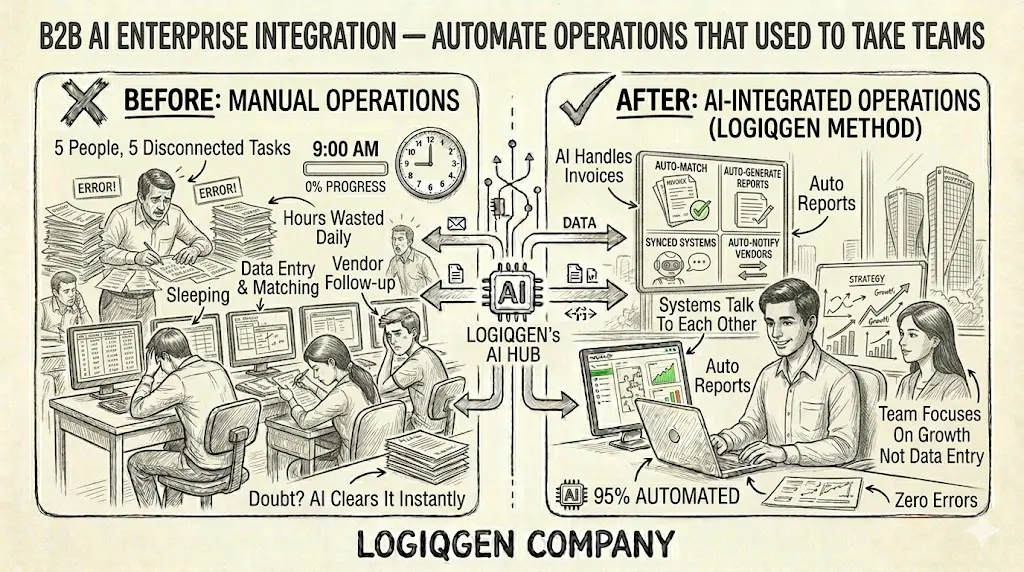
Why Are Manual Workflows The Biggest Hidden Cost In Indian Businesses?
Most businesses have grown by adding people to handle increasing operational complexity. More orders means more data entry. More vendors means more invoice reconciliation. More clients means more report generation. Each of these tasks is individually small, but collectively they consume thousands of person-hours every month — time your team could spend on strategic work that actually grows the business.
The real cost is not just salaries. Manual processes introduce errors — transposed numbers in invoices, missed follow-ups, inconsistent data across systems. These errors trigger cascading corrections, customer disputes, compliance issues, and management time spent investigating what went wrong. A single data entry mistake in an order management system can ripple through procurement, production, delivery, and billing.
B2B AI enterprise integration addresses this at the root. Instead of adding more people to manage growing complexity, you deploy intelligent automation that handles repetitive, rule-based, and data-intensive workflows — faster than humans, without errors, and at a fraction of the ongoing cost. The key distinction from traditional automation is intelligence. Rule-based scripts break when they encounter an invoice formatted differently or a vendor name spelled inconsistently. AI-powered integration handles variation — it reads invoices regardless of format, matches vendor names despite spelling inconsistencies, and learns from corrections rather than failing silently.
What Does B2B AI Integration Actually Automate For Hyderabad Companies?
Invoice processing and accounts payable. AI reads incoming invoices — PDFs, scanned documents, emails — extracts line items, validates against purchase orders, flags discrepancies, and posts approved entries to your accounting system. What takes a team hours of manual matching completes in minutes with higher accuracy.
Cross-system data synchronization. Most businesses run separate systems for CRM, ERP, accounting, inventory, and HR. Data entered in one system needs to appear in others. AI-powered integration keeps these systems synchronized in real time — when a sales order closes in the CRM, inventory is updated, production is scheduled, and invoicing is triggered automatically.
Report generation and business intelligence. AI aggregates data from multiple sources, generates formatted reports on schedule, and highlights anomalies and trends that would take an analyst hours to identify manually. Your management team gets decision-ready insights instead of raw spreadsheets.
Customer communication workflows. Order confirmations, shipping notifications, payment reminders, contract renewals — these follow predictable patterns that AI handles end-to-end. The system personalizes each communication based on customer history and triggers human involvement only when the situation requires judgment.
Vendor management and procurement. AI monitors inventory levels against consumption rates, generates purchase orders when stock reaches reorder thresholds, compares vendor pricing across historical data, and tracks delivery performance — turning procurement from a reactive scramble into a proactive, data-driven operation.
How Does LogiQGen Implement B2B AI Integration For Hyderabad Enterprises?
We begin with a process mapping exercise. Our team documents your current workflows step by step — who does what, how long it takes, where errors occur, and what systems are involved. This is not a generic assessment. We sit with your operations, finance, and sales teams to understand the actual day-to-day reality, not the idealized process diagram.
From the process map, we identify the highest-impact automation opportunities — workflows that consume the most time, have the highest error rates, or create the biggest bottlenecks. We prioritize these based on implementation complexity and business value, creating a phased roadmap that delivers measurable ROI from the first deployment.
Integration is built using APIs, webhooks, and AI middleware that connects your existing systems without replacing them. We do not ask you to switch your ERP or abandon your CRM. We build the intelligent layer that makes your existing tools work together seamlessly — Tally, Zoho, Salesforce, SAP, custom databases, spreadsheets — whatever your business runs on today.
After deployment, we monitor automation performance for 30 days, measure actual time savings against baseline, and refine the AI models based on real transaction data. Most implementations show clear ROI within the first 60 days — not as a projected estimate, but as measured hours saved and errors eliminated.
Which Types Of Businesses In Hyderabad Benefit Most From AI Integration?
Manufacturing companies with complex supply chains, multiple vendor relationships, and high-volume order processing. AI integration connects production planning with procurement, inventory, and dispatch — eliminating the manual coordination that causes delays and stockouts.
Distribution and logistics companies that process hundreds of orders daily across multiple channels. AI automates order intake, warehouse allocation, route optimization, and delivery tracking — reducing processing time per order from minutes to seconds.
Professional services firms — accounting practices, consultancies, and agencies that spend significant time on timesheet reconciliation, client billing, and project status reporting. AI automates the administrative overhead so professionals spend more time on billable client work.
Retail and e-commerce businesses managing inventory across multiple platforms, processing returns, and reconciling payments from multiple gateways. AI keeps everything synchronized and flags exceptions for human review instead of requiring manual checking of every transaction.
Healthcare organizations managing patient records, insurance claims, appointment scheduling, and regulatory reporting across disconnected systems. AI integration creates a unified operational layer that reduces administrative burden and improves compliance.
Construction and real estate firms juggling project timelines, vendor payments, material procurement, and regulatory approvals across dozens of concurrent projects. AI connects project management with procurement and accounting — automatically matching material deliveries to purchase orders, flagging budget overruns before they escalate, and generating progress reports that would take project managers hours to compile manually.
What Results Do Hyderabad Businesses See After B2B AI Integration Is Deployed?
Businesses that deploy B2B AI integration typically see manual data entry time reduce by 70 to 85 percent within the first 90 days. Processing errors — the ones that cause customer complaints, vendor disputes, and audit findings — drop by 90 percent or more because AI does not transpose numbers, skip entries, or forget follow-ups.
The productivity shift is significant. Teams that previously spent their days on operational processing start spending their time on exception handling, relationship building, and strategic analysis. The business does not need fewer people — it needs the same people doing higher-value work. AI handles the volume; your team handles the judgment.
The less visible but equally valuable outcome is data integrity. Manual processes corrupt data — inconsistent formatting, duplicate entries, missing fields, outdated records that nobody cleaned up. When transactions flow through validated AI pipelines, your business database becomes a reliable single source of truth for the first time. Financial projections become more accurate. Inventory counts match physical stock. Customer records reflect reality instead of approximation. This data cleanliness is the prerequisite for every advanced analytics initiative your business will pursue in the coming years.
What Does AI Automation Look Like In Real-World Hyderabad Business Scenarios?
Scenario: A Hyderabad-based distribution company processing 300 orders per day. Before AI integration, their operations team manually entered orders from WhatsApp messages, emails, and phone calls into their inventory management system. Each order took 4 to 6 minutes to process — find the customer record, verify stock availability, enter line items, calculate pricing, generate the invoice. At 300 orders daily, this consumed 20 to 30 person-hours of pure data entry. After AI integration, incoming orders from all channels are automatically parsed, validated against inventory, and entered into the system. The operations team now reviews exceptions — unusual quantities, new customers, out-of-stock items — instead of processing every order manually. Processing time per order dropped from minutes to seconds. The same team handles 40 percent more order volume without adding staff.
Scenario: A mid-sized accounting firm reconciling client transactions across multiple banks. Their analysts spent the first three hours of every workday downloading bank statements, matching transactions against ledger entries, and flagging discrepancies. Eighty percent of transactions matched perfectly and required no human judgment — but the analysts had to check each one anyway because they were mixed in with the exceptions. After AI integration, the reconciliation engine matches straightforward transactions automatically overnight and presents only the genuine exceptions for analyst review each morning. Three hours of mechanical matching became 30 minutes of focused exception handling. The freed time goes directly into advisory work that the firm bills at higher rates.
Scenario: A pharmaceutical wholesaler managing vendor payments and compliance documentation. Regulatory requirements demanded that every payment to a drug manufacturer be accompanied by specific documentation — GST certificates, drug license copies, batch certificates. The compliance team manually tracked which documents were current, which had expired, and which vendors had outstanding paperwork. After AI integration, the system automatically monitors document expiry dates, sends renewal reminders to vendors, holds payments when required documentation is missing, and maintains an audit-ready compliance trail. No more last-minute scrambles before regulatory inspections.
What Makes LogiQGen's Approach To B2B AI Integration Different From Other Companies?
Most automation consultancies start with the technology and look for processes to apply it to. We start with your actual operations and work backward to the right technology. The difference matters because not every manual process should be automated. Some processes are manual because they require genuine human judgment. Others are manual because nobody got around to automating them yet. The distinction determines where AI investment delivers returns and where it creates complexity without value.
We insist on measuring baseline performance before deployment — actual time spent, actual error rates, actual costs. This is not a formality. It is the foundation of accountability. When we say the AI integration reduced invoice processing time by 75 percent, that number is measured against a documented baseline, not estimated from a theoretical model. You see the before and after in your own operational data.
Our integration architecture is designed for resilience, not just efficiency. Every automated workflow includes human-accessible override controls. If the AI encounters a scenario it has not seen before — an unusual invoice format, a new vendor structure, an edge case in your approval hierarchy — it escalates to a human rather than guessing. The system is transparent about its confidence level. High-confidence actions proceed automatically. Low-confidence actions queue for review. This graduated autonomy builds trust over time as the AI encounters and learns from more of your business scenarios.
Post-deployment support is not an add-on — it is part of how we work. For the first 90 days after launch, our team monitors every automated workflow, measures accuracy against baseline, and tunes the AI models based on real transaction data from your business. The system you have at day 90 is measurably better than the system we deployed at day one, because it has been refined using your actual operational patterns.
Scalability is designed into the architecture from the beginning. The integration that handles 300 transactions per day on launch can handle 3,000 per day without re-engineering. As your business grows — new product lines, additional vendors, higher order volumes, expansion to new geographies — the AI layer scales with you. We have seen clients double their transaction volume within a year of deploying AI integration, handling the increased load with the same team size because the automated workflows absorbed the growth.
Change management is the final piece that most automation providers neglect. Your team needs to trust the system before they rely on it. We build that trust through transparency — every automated action is logged and reviewable, every AI decision shows its reasoning, and every exception is clearly explained. Within the first month, operations teams typically shift from cautiously double-checking automated outputs to confidently focusing their attention only on the flagged exceptions. That behavioral shift — from verification mode to exception-handling mode — is when the real productivity gains materialize.
Frequently Asked Questions About B2B AI Integration For Indian Enterprises
Do we need to replace our existing ERP or CRM to use AI integration? No. LogiQGen builds the AI layer on top of your existing systems — Tally, Zoho, Salesforce, SAP, or custom databases. Your team continues using the tools they already know. The AI connects and automates workflows between them without replacing anything.
How long does B2B AI integration take to implement? The first automated workflow typically goes live within 3 to 4 weeks. A comprehensive multi-workflow integration covering invoicing, reporting, and cross-system sync takes 8 to 12 weeks. Each phase delivers measurable value independently.
What is the cost of B2B AI integration for a mid-sized Hyderabad company? Costs depend on the number of workflows being automated, the systems being connected, and the transaction volume. LogiQGen provides a detailed cost estimate and projected ROI calculation after the free process mapping consultation.
Is our business data safe during and after integration? Yes. All data flows through encrypted channels. AI processing happens within your infrastructure or your dedicated cloud environment. LogiQGen does not store or access your transaction data. Role-based access controls ensure only authorized team members see relevant information.
What happens if the AI makes a mistake on an invoice or data entry? Every automated action includes confidence scoring. High-confidence transactions process automatically. Low-confidence or unusual transactions are flagged for human review before processing. The system never makes irreversible changes without appropriate confidence thresholds being met.