
Why Are Off-The-Shelf Language Models Not Enough For Serious Business Use in Hyderabad?
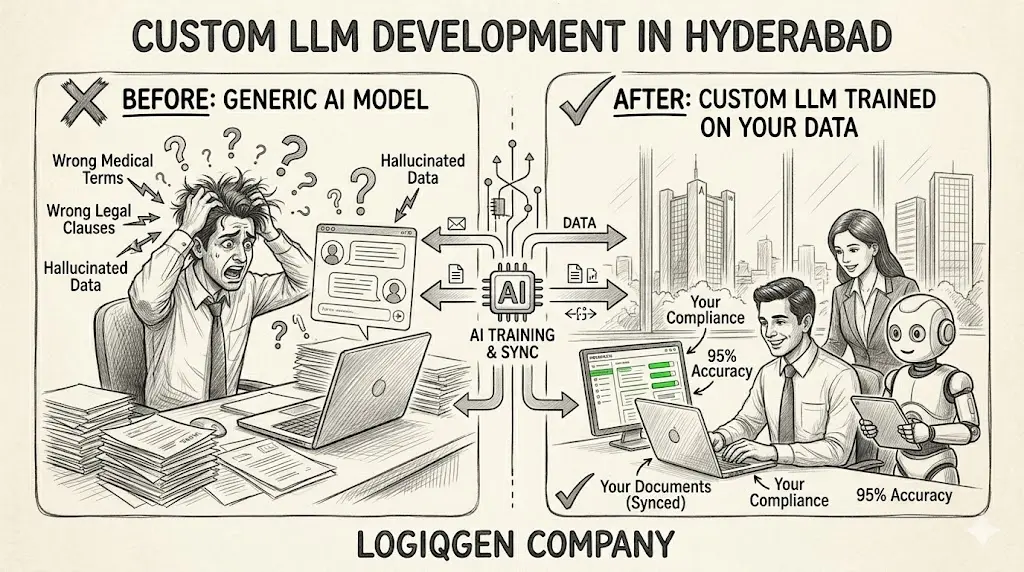
General-purpose language models like GPT or open-source alternatives are trained on broad internet data. They can write emails, summarize articles, and answer general questions reasonably well. But the moment you need them to handle your industry's specific terminology, comply with your regulatory framework, or reason about your proprietary processes, they start producing confident-sounding answers that are factually wrong.
A pharmaceutical company in Hyderabad cannot rely on a generic model to draft regulatory submissions — it needs a model that understands CDSCO guidelines, molecule nomenclature, and clinical trial terminology with zero room for hallucination. A legal firm cannot use a model that confuses Indian contract law with American precedent. A manufacturing company cannot trust a model that gives generic maintenance advice when it needs to reason about the specific failure modes of their CNC machines.
This is the core problem custom LLM development solves. Instead of forcing a general model to guess at your domain, you build — or fine-tune — a language model that has been specifically trained on your data, your documents, and your decision-making patterns. The result is an AI that performs like a senior domain expert rather than an enthusiastic generalist.
What Exactly Is Custom LLM Development And How Does It Work For Hyderabad Businesses?
Custom LLM development is the process of creating or adapting a large language model so it becomes specialized for your specific business domain. This can range from fine-tuning an existing foundation model on your proprietary data to building retrieval-augmented generation (RAG) pipelines that ground the model's responses in your actual documents and databases.
Fine-tuning involves training the base model further on your domain-specific dataset — your internal documents, customer interactions, product specifications, compliance records. The model learns the patterns, terminology, and reasoning specific to your field. After fine-tuning, it produces outputs that reflect your domain knowledge rather than generic internet knowledge.
RAG (Retrieval-Augmented Generation) takes a different approach — instead of retraining the model, it connects the model to your knowledge base at query time. When someone asks a question, the system first retrieves the most relevant documents from your data, then feeds them to the language model as context. The model generates answers grounded in your actual data rather than its training memory.
Private deployment means the model runs on your infrastructure — your cloud account or your on-premise servers. Your data never leaves your environment. This is non-negotiable for industries like healthcare, finance, and legal where data sovereignty and compliance are requirements, not preferences.
Hybrid approaches combine fine-tuning and RAG to deliver the best of both worlds. The base model is fine-tuned to understand your domain's language and reasoning patterns, while the RAG layer ensures every response is grounded in your current, up-to-date documents. This means the model both thinks like a domain expert and cites from your actual knowledge base — producing outputs that are both contextually intelligent and factually verifiable. LogiQGen recommends this approach for businesses that need both deep domain reasoning and access to frequently updated information.
Which Industries In Hyderabad And Telangana Benefit Most From Custom LLMs?
Healthcare and Pharma — Custom LLMs trained on medical literature, drug interaction databases, and clinical protocols can assist doctors with differential diagnosis, help pharma teams draft regulatory documents, and power patient-facing health assistants that give medically accurate responses instead of generic wellness advice.
Legal and Compliance — Law firms and compliance teams need models that understand Indian legal frameworks, case law databases, and regulatory terminology. A custom LLM can draft contract clauses, review agreements for risk, and answer compliance queries with citations to actual regulations — not hallucinated legal advice.
Financial Services — Banks, NBFCs, and fintech companies use custom LLMs for credit risk assessment narratives, regulatory reporting, customer query resolution, and fraud pattern analysis. The model needs to reason about RBI guidelines, not generic financial concepts.
Manufacturing and Engineering — Custom LLMs trained on equipment manuals, maintenance logs, and quality control data can assist engineers with troubleshooting, generate inspection reports, and predict failure patterns based on historical data specific to your production lines.
Research and Education — Universities and research institutions use custom LLMs to process domain-specific academic papers, assist with literature reviews, and build intelligent tutoring systems that understand the exact syllabus and learning objectives of their programs.
How Does LogiQGen Build Custom LLMs For Hyderabad Businesses?
We start with a data and workflow audit. Before writing any code, we understand what your team actually does with information — what questions they answer, what documents they reference, what decisions they make. This determines whether you need fine-tuning, RAG, or a hybrid approach.
Next, we prepare your data. This involves cleaning, structuring, and annotating your domain documents so the model can learn from them effectively. Poor data preparation is the single biggest reason custom LLM projects fail — we invest significant effort here because the quality of your model directly depends on the quality of your training data.
We then select the right base model and architecture. Not every use case needs the largest model. Sometimes a well-tuned smaller model running on modest hardware outperforms a massive model on domain-specific tasks while costing a fraction to operate. We optimize for accuracy-per-rupee, not parameter count.
After development, we deploy the model in your environment with proper monitoring, version control, and feedback loops. The model improves continuously as your team uses it and provides corrections. Within 60 to 90 days, most deployments reach a level of domain accuracy that would take a new human hire months to develop.
What Results Should You Expect From A Custom LLM In Your Business?
Businesses that deploy custom LLMs typically see domain-specific task accuracy improve from 60 to 70 percent (generic model) to 90 to 95 percent (custom model). Document processing time drops significantly — tasks that took analysts hours to complete are handled in minutes with human review only for edge cases.
The operational impact goes beyond speed. Custom LLMs reduce dependency on tribal knowledge — the expertise that lives in senior employees' heads and disappears when they leave. By encoding that knowledge into a model, you create an institutional asset that scales with your team rather than being bottlenecked by individual availability.
Compliance risk decreases because the model is trained to follow your specific regulatory frameworks rather than generating plausible-sounding but potentially non-compliant outputs. And because the model runs privately, you maintain full control over your data — no sensitive information is sent to third-party APIs.
The businesses seeing the strongest returns from custom LLMs are those where domain expertise is the bottleneck — where the volume of specialized questions and documents outpaces the availability of qualified people to handle them. If that describes your operations, a custom LLM closes that gap permanently.
How Does A Custom LLM Compare To Generic AI For Indian Decision Makers?
Decision makers often ask whether the investment in a custom LLM is justified when generic models keep improving. The answer depends on what your business actually needs the model to do. If you need it to write marketing emails or summarize news articles, a generic model is sufficient. If you need it to process your legal contracts, interpret your engineering specifications, or generate outputs that your compliance team can sign off on without extensive manual review, a generic model will cost you more in correction time than it saves in automation.
Consider the total cost of errors. When a generic model hallucinates a clause in a legal document, someone on your team catches it — hopefully before it reaches the client. That catch-and-correct cycle happens dozens of times per day. Over a quarter, the accumulated cost of human review and error correction often exceeds the one-time cost of building a custom model that gets it right the first time.
There is also the question of competitive advantage. A generic model gives every business the same capability. A custom LLM trained on your proprietary data — your client interactions, your internal processes, your domain expertise accumulated over years — gives you a capability that no competitor can replicate by simply signing up for the same API. It is the difference between renting a tool that everyone has access to and owning an asset that compounds in value over time.
Hyderabad businesses operating in regulated industries — pharma, financial services, legal, healthcare — face an additional constraint. Generic models cannot guarantee where your data goes or how it is stored. A privately deployed custom LLM gives you auditable control over every piece of data the model processes. For businesses subject to SEBI, RBI, CDSCO, or IRDAI oversight, this is not a feature — it is a prerequisite.
What Are The Most Common Questions About Custom LLM Development?
Is custom LLM development only for large enterprises? No. The cost and complexity of building custom language models has decreased dramatically. Mid-sized businesses in Hyderabad with 50 to 500 employees routinely deploy custom LLMs — particularly when they operate in specialized domains where generic models consistently underperform. The question is not company size but data specificity. If your domain knowledge is specialized enough that generic models struggle with it, you benefit from customization regardless of your headcount.
How much data do I need? Less than most people assume. For RAG-based systems, your existing document library — internal wikis, SOPs, product manuals, compliance documents — is often sufficient from day one. For fine-tuning, we typically work with datasets starting at a few thousand domain-specific examples. The key factor is data quality and relevance, not volume. A curated dataset of 5,000 high-quality examples from your actual workflows outperforms 500,000 scraped generic examples every time.
How long does it take? A RAG-based custom LLM using your existing documents can be production-ready in 3 to 4 weeks. A fine-tuned model with custom training typically takes 6 to 10 weeks from data preparation to deployment. These timelines include testing, iteration, and integration with your existing systems — not just model training.
What happens if my domain knowledge changes? The model evolves with your business. RAG-based systems update immediately when you add new documents to the knowledge base. Fine-tuned models can be retrained periodically — quarterly or semi-annually — to incorporate new terminology, updated regulations, or evolved processes. The system is designed to be a living asset, not a static snapshot.
Can I measure the ROI before committing fully? Absolutely. We recommend starting with a focused pilot — one department, one use case, one workflow. Measure the pilot against clear baselines: time to process a document, accuracy of generated outputs, number of escalations to senior staff. Most pilot deployments produce enough data within 30 days to project full-deployment ROI with confidence. The decision to scale becomes data-driven rather than faith-based.
What about model security and access control? Enterprise deployments include role-based access controls, audit logging of every query and response, and the ability to restrict which users or departments can access which portions of the knowledge base. A legal team's confidential contract database remains invisible to the marketing team, even though both use the same underlying model. Data compartmentalization is built into the architecture, not bolted on as an afterthought.
Frequently Asked Questions About Custom LLM Development in Hyderabad
How much does custom LLM development cost in India? Costs depend on the approach — a RAG-based system using your existing documents starts at a significantly lower investment than a fully fine-tuned model. For most mid-sized Hyderabad businesses, the initial deployment ranges from a few lakhs to mid double digits depending on data complexity and integration requirements. LogiQGen provides a detailed estimate after the free consultation based on your specific use case.
How long does it take to build a custom LLM? A RAG-based custom LLM can be production-ready in 3 to 4 weeks. A fine-tuned model typically takes 6 to 10 weeks from data preparation to deployment. Both timelines include testing, integration with your systems, and team training.
Do I need a large dataset to build a custom LLM? No. For RAG systems, your existing internal documents — SOPs, manuals, compliance records, product specs — are usually sufficient from day one. For fine-tuning, as few as 3,000 to 5,000 high-quality domain-specific examples can produce strong results. Quality matters far more than quantity.
Who owns the custom LLM after it is built? You do. LogiQGen builds on open-source base models and deploys on your infrastructure. You own the fine-tuned weights, the data pipeline, and the entire system. There is no vendor lock-in.
Can a custom LLM integrate with our existing CRM and ERP systems? Yes. LogiQGen builds API-based integrations that connect your custom LLM with Salesforce, Zoho, SAP, Tally, and any system that supports API access. The LLM can read from and write to your existing business systems as part of automated workflows.