
Key points
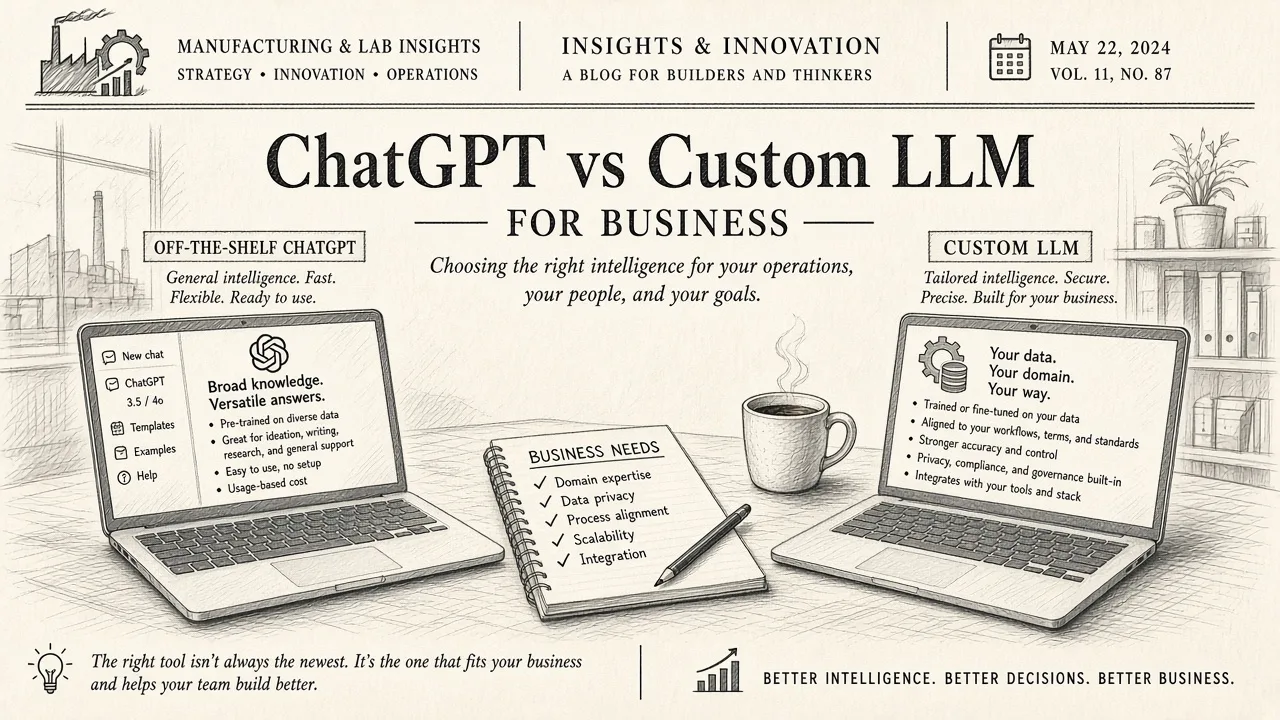
ChatGPT is a ready-made tool for everyday tasks. A custom LLM for business is built to work with your documents, rules, and apps.
Choose ChatGPT when the work is generic. Choose a custom LLM when accuracy depends on private company data, sensitive information, or fixed business rules. Many companies use both.
What is ChatGPT, and what is a custom LLM?
ChatGPT is a plug-and-play AI tool. Teams use it to create content, answer questions, summarise information, help with coding, and support daily work — usually without a custom build.
A custom LLM application connects a language model to your business data, apps, and processes. For a software company, that might mean answering from product docs and internal processes — something a generic chatbot cannot see unless you connect it properly.
In short: ChatGPT is a general-purpose assistant. A custom LLM application is shaped for your specific business needs. For official product details on ChatGPT plans and controls, see OpenAI.
When is a ready-made tool like ChatGPT enough?
Not every business needs its own AI model. If the job is everyday work, a ready-made tool is often the practical choice.
A small marketing team writing blogs, posts, presentations, and emails can use ChatGPT to draft content, organise ideas, improve wording, and summarise long documents — without a development project.
If your main need is support for everyday activities, and a public tool already meets the requirement, you do not need a separate application yet.
When do you need a custom LLM?
The decision changes when AI must work with your own information.
If employees dig through hundreds of product, customer, or process documents for answers, a custom assistant can connect the model to that knowledge base. One common approach is Retrieval-Augmented Generation (RAG): the system retrieves approved internal passages, then answers from them.
That pattern fits customer support, internal knowledge, and any workflow where company-specific facts matter more than open-web fluency. It also fits AI chatbot projects that must not invent prices or policies.
Your own data
If answers must come from your catalogue, SOPs, tickets, or manuals, a custom setup beats a generic chat window that has never seen those files.
Sensitive data
Customer records, finance, HR, and internal docs need clear control over storage and access. That is where private AI for business usually means a custom application with your rules — not a casual paste into a public chat.
Your rules
If the assistant must follow fixed pricing, escalation paths, or “hand off to a human when unsure,” those rules belong in a controlled build, not in hope.
Data control, accuracy, and cost over time
Data control. Businesses handle customer information, financial records, employee details, and internal documents. ChatGPT offers different privacy and admin controls by plan. A custom app can add hosting choices, source limits, and team permissions — for example HR-only access to employee data while sales sees product and customer material. Building custom does not guarantee security by itself; authentication, encryption, and access control are still required.
Accuracy. ChatGPT is strong on general writing, research, content, and coding help. A custom LLM application is stronger when the answer must match your documentation. Marketing may use ChatGPT for drafts; support may need a custom assistant grounded in product docs so it does not invent features.
Cost over time. Buying ChatGPT is usually faster to start: pick a plan or API and begin. A custom LLM needs development, infrastructure, data preparation, testing, and maintenance. For content-heavy small teams, buy first. For repeated, data-heavy workflows, a custom path can cost less to regret over time. Related reading: how much custom AI app development costs in India.
A simple 3-question decision guide (build or buy)
Before you spend, answer these three questions. This is the same build-or-buy logic we use in discovery calls at LogiQGen in Hyderabad.
1. What do you want AI to do?
Everyday drafting and research → ChatGPT is usually enough. Answers from internal documents and systems → lean custom.
2. Whose data must it use?
Public or non-sensitive material → ready-made tools can work. Confidential customer or employee data → prioritise private AI for business with clear access rules.
3. How long will this matter?
One-off productivity help → buy. AI inside daily workflows and apps for the next year → a custom solution usually offers more control and flexibility.
Can businesses use both?
Choosing ChatGPT vs custom AI does not mean picking only one forever.
Use ChatGPT for writing, research, and preparing documents. Use a custom AI assistant for internal information and specific workflows. A software company can use ChatGPT to learn new tech, while developers use an internal assistant to search project documents.
That mix lets you benefit from existing tools while building custom pieces only where they create real value.
Final thoughts
The choice between a custom LLM and ChatGPT depends on what your business actually needs — requirements, budget, and future plans.
If you need AI for everyday tasks, ChatGPT is a good place to start. If you need an assistant that understands your data, follows business rules, and connects to your applications, a custom LLM is worth considering.
Do not choose a technology only because it is popular. Solve the problem first. Then decide whether buying an existing tool or building a custom solution makes more sense. The goal is not “add AI.” The goal is easier daily work and real value.
Frequently asked questions
Is ChatGPT enough for a small business?
Often yes, if you mainly need writing, research, summaries, and drafting. Start there. Move to a custom LLM when answers must come from your own documents or customer data.
What is a custom LLM for business?
It is an AI application built around your data, rules, and systems — often using retrieval from approved documents — so answers match your products and processes, not the open internet.
Is a custom LLM more private than ChatGPT?
It can be, when you control hosting, access, and which sources the model may use. Privacy still needs authentication, encryption, and clear permissions — a custom build is not automatic security.
Can we use both ChatGPT and a custom LLM?
Yes. Many teams use ChatGPT for general work and a custom assistant for internal knowledge, support, or workflows that must stay on company data.
How do we decide build or buy?
Ask three questions: What must AI do? Whose data must it use? How long will this matter? Generic tasks favour buy. Your data, rules, and long-term workflows favour a custom build.