
What happened on the Berlin stage
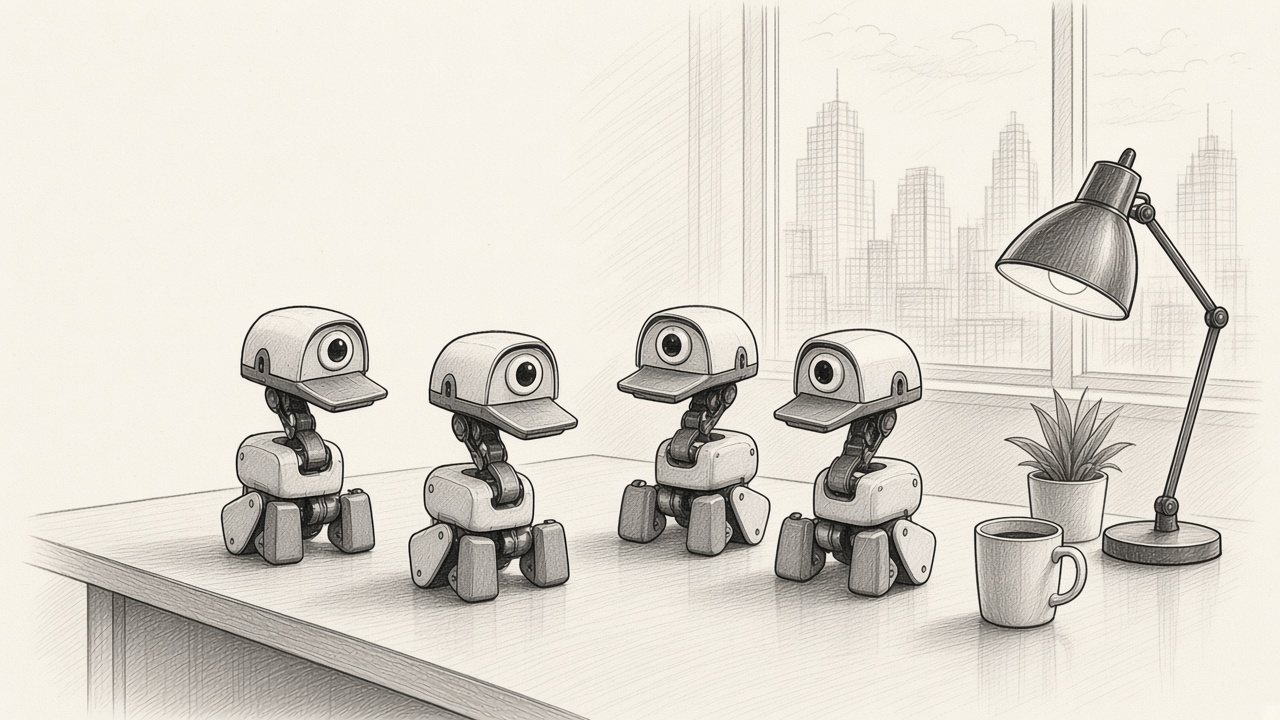
On 21 October 2026, at NVIDIA’s GTC in Berlin, Jensen Huang stood with four small robots shaped like ducks. He asked them to sit. They sat. He asked for a nap, and three of them tipped over on purpose. That is their version of lying down. One stayed upright. Huang told that one to pay attention and stay focused. Then he asked for a somersault.
The clip spread quickly. Clem Delangue at Hugging Face said preorders passed 20,000 within about a day. That figure is the company’s own count, and a preorder is a reservation. People started talking about them as a Christmas toy. They are about 25 centimetres tall, weigh under 800 grams, and cost $399. In the videos they waddle and make small electronic noises.
Who built the ducks
The robots come from Pollen Robotics, the Bordeaux team inside Hugging Face. NVIDIA did not manufacture them. Pollen started in 2016 as a spinout from INRIA, the French research institute. Hugging Face bought the team in April 2025. Microduck is their second small robot, after Reachy Mini.
NVIDIA’s name is on the demo because Huang showed the ducks, and because the practice runs used NVIDIA’s software. In September 2026 NVIDIA agreed to buy Hugging Face. That sale is expected to close in the first half of 2027. The people who designed the 15 motors were at Pollen.
How a somersault gets learned
A Microduck has 15 motors. Each one can be a little early, a little late, or simply wrong. Writing a somersault by hand means guessing a long chain of positions. A different floor, or a start that is half a step off balance, and that written version falls. The team stopped treating every new skill as a script.
They build a copy of the robot in a simulator. Similar weight. Similar legs. The same number of motors. An AI model is allowed to try the move. A fall scores badly. Landing on its feet, or finishing the roll and getting back up, scores well. Then it tries again. Thousands of times. A person cannot keep picking up a real duck and setting it back on its feet all night. A simulation can reset itself and keep going.
Pollen used NVIDIA’s stack for that practice. NVIDIA has shown the path as simulation first, then the real Microduck, with AI agents on RTX Spark helping carry a skill from the fake room into the body. Walking, sitting, and standing ship with the robot because they were learned this way. The nap and the somersault on stage came from the same kind of practice.
The heavy practice happens before the duck is switched on
Microduck stays light because the chip inside it is a Rockchip RK3566, a small processor. The robot also has a camera, a depth sensor, and sensors that tell it which way is down. The beak can pick up small objects. That is enough to see the space in front of it and to run a skill it already has.
The long search for what the legs should do is finished before you switch it on. A good version of the skill, the model’s habit of movement, is loaded onto the robot. On stage, the duck is running something it already practiced, and adjusting that habit to what its sensors see at that moment.
The nap makes this easy to see. Three ducks had the timing. One did not. A learned skill is a habit that works often. It still misses sometimes. Anyone who has watched a child try the same jump ten times will recognise it, even though the duck is plastic and motors.
What an owner can add
The tricks it ships with are a start. Pollen says an owner can train a new one and share it with other people who have the same robot. The next person opens the box with more than a duck that only knows how to fall over.
A somersault found in simulation can help every duck with the same body. Someone trains a trick, shares it, and other people try it. Gravity is less patient than a sentence. The method is still the same. Learn it where failure is cheap. Pass the result to the machines that have to live with real floors.
What the clip is actually showing
A Microduck has no feeling of a nap. It has a score for ending up on its side when a nap was asked for, and another score for getting up again. Do that enough times in a simulator and the body starts to look as if it knows the joke.
The work was in the practice room. The duck fell, many times, somewhere nobody had to walk over and pick it up. By the time Huang called for a somersault, it only had to repeat a version that had already worked.