
Key points
AI for small business India does not start with a platform. It starts with five readiness questions, one painful use case, and a 30-day pilot you can measure.
How to start with AI: pick work that already repeats, use data you already keep, and prove one channel before you expand. Start with one report, one process, one pilot — then keep only what saved time or money.
Are you ready for AI? Five questions that decide
AI readiness is not a score from a vendor slide. It is five plain answers. If you cannot answer them, pause the buy and fix the gap first. LogiQGen uses this list in discovery calls with Hyderabad SMEs before any custom LLM or chatbot quote.
1. What work already repeats every week?
Look for the same report, the same enquiry, the same follow-up. If a person does the same steps more than a few times a week, that work is a candidate. One-off creative judgement is not.
2. Is the data already in files or software?
AI needs a source of truth: PDFs, a catalogue, CRM notes, Excel that someone trusts, or a help desk history. If the answer lives only in one person’s head or scattered WhatsApp forwards, clean that first — or the pilot will invent answers.
3. Which delays already cost money?
Missed leads after hours, late status replies, slow invoice checks, or a queue that waits on one report. Name the delay in rupees or lost hours. If you cannot measure the pain, you cannot prove the pilot worked.
4. Can you protect time for a pilot?
Someone must own the use case, approve the data, and review real outputs each week. If nobody has two hours a week for that, the pilot will stall. A tool without an owner is shelfware.
5. Can you decide quickly when something works or fails?
Agree in writing what “good enough” means before day one: accuracy on a test set, response time, or handoff rate. Slow committees kill pilots. Fast, honest reviews grow them.
How do you choose the first AI use case?
Choose the smallest job that still hurts. Good first use cases share three traits: they happen often, the rules are clear, and the data already exists. Bad first use cases try to “add AI everywhere” or replace a whole team in month one.
Examples that fit many Indian SMEs: after-hours product questions on WhatsApp, status replies for orders or lab reports, internal search over approved SOPs, or a first-pass draft of a weekly ops report. An AI chatbot on one channel is often enough for the first slice.
Write one sentence: “In 30 days, AI will do X from Y data, and we will measure Z.” If that sentence needs three “and also” clauses, cut the scope.
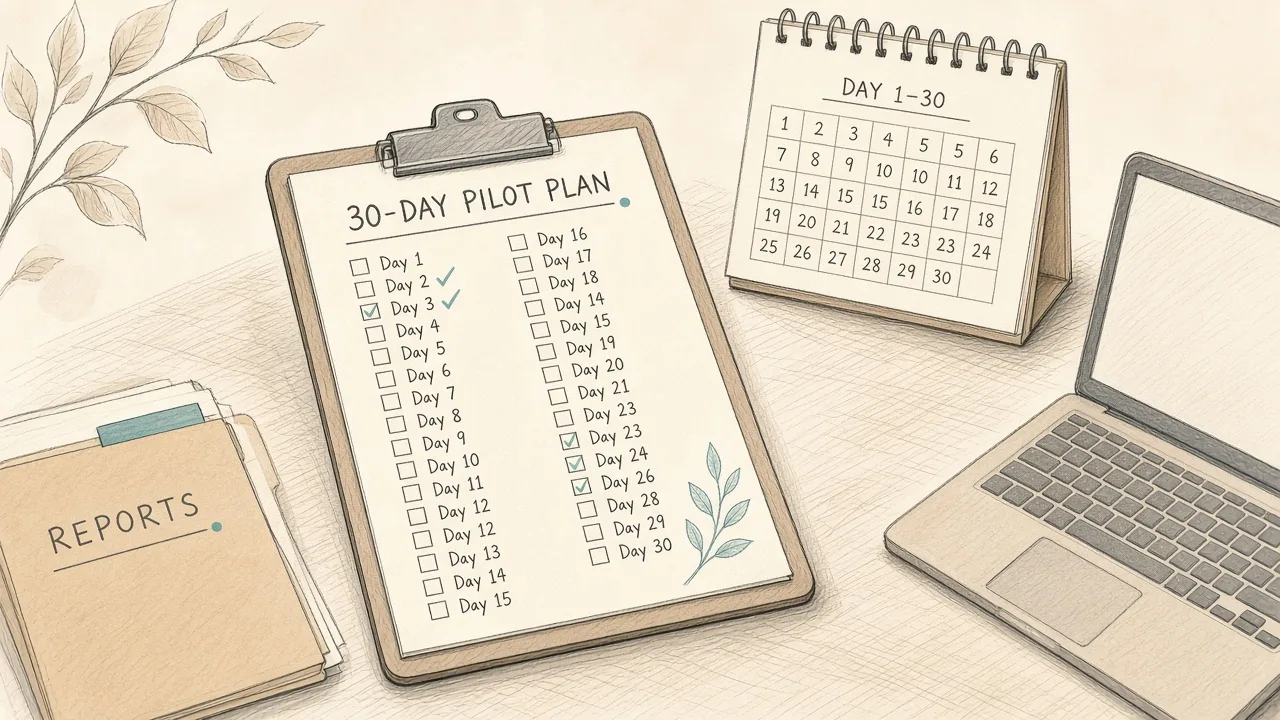
A simple 30-day AI pilot plan
This plan is a calendar, not a transformation programme. Keep one owner, one use case, and one success metric. Adjust the days to your week — keep the order.
Days 1–7: Define and collect
Confirm the five readiness answers. Write the one-sentence use case and the success metric. Collect only the approved files or system exports the pilot may use. List what the AI must never invent (prices, medical advice, legal promises). Name the human handoff path.
Days 8–21: Build a thin slice
Connect the model to that approved set — not the open web as a substitute for your data. Ship one channel (web or WhatsApp). Test on real questions your team already gets. Fix wrong answers by improving the source or the rules, not by hoping the model “learns” in silence.
Days 22–30: Run, review, decide
Put the pilot in front of a small group of real users. Log misses and handoffs. Compare results to the success metric you wrote on day one. Then decide: expand, rewrite the scope, or stop. That decision is the point of the month.
Common mistakes that waste the first month
Starting with a platform, not a problem. Buying five tools before you name the repeat work burns budget and trust.
Feeding messy data. Screenshots, old price lists, and undocumented exceptions produce confident wrong answers. Clean or limit the source first.
No human handoff. When the assistant is unsure, a person must take over. Silence or guessing is worse than a slow but honest reply.
Measuring nothing. “It feels smarter” is not a result. Track time saved, leads caught, or error rate on a fixed test set.
Skipping ChatGPT where it is enough. Everyday drafting does not need a custom build. Save custom work for your data and your rules — see Custom LLM vs ChatGPT for business.
What LogiQGen looks for before quoting a pilot
In anonymised Hyderabad SME work, the pilots that finish on time shared one pattern: one painful channel, a catalogue or SOP set someone already trusted, and a named owner who reviewed logs weekly. The pilots that dragged tried to cover every department and every language on day one.
We price the slice you can prove — not a dream platform. If your first month looks like “one report, one process, one pilot,” you are ready to talk scope. For how cost usually breaks down after that first slice, read how much custom AI app development costs in India.
For public guidance on responsible AI and data handling in India, also see IndiaAI and MeitY. Those pages do not replace your own policies — they remind you why access rules and logs belong in the pilot from week one.
Final thoughts
How to start with AI as a small or medium business is simpler than the market noise suggests. Prove readiness, choose one use case, run thirty days, and keep only what worked.
You do not need to automate the company. You need one clear win your team can point to. Start with one report, one process, one pilot.
Frequently asked questions
Do I need a big budget to start with AI?
No. Start with one use case and a short pilot. A focused build on approved data costs less than a full platform — and gives you a real number instead of a guess. See our guide on custom AI app development cost in India.
What is AI readiness for a small business?
AI readiness means you can name repeat work, point to usable data, measure a delay that costs money, protect time for a pilot, and decide quickly when something works or fails. If those five are unclear, fix readiness before you buy tools.
Should we use ChatGPT or a custom AI pilot first?
Use ChatGPT for everyday drafting and research. Run a custom pilot when answers must come from your own reports, prices, or processes. Related reading: Custom LLM vs ChatGPT for business.
How long should the first AI pilot take?
Thirty days is enough for one narrow use case: define success in week one, build a thin slice in weeks two and three, and review real results in week four. Do not try to automate the whole company in one month.
What if the pilot fails?
A failed pilot still teaches you which data was missing, which process was unclear, or which success metric was wrong. Write that down. Then either fix the scope or stop — that is cheaper than a silent roll-out nobody uses.